
Since I began working more extensively in design, I have found it difficult to look only at what “appears” onstage. I notice where one body gives its weight, which corner a sound enters from, and how light suddenly gives depth to what had seemed like a flat space. I also begin to notice myself: Where am I sitting? How far am I from the performers? Have I been looking in the same direction for too long? At what point does my body want to move closer, and when does it want to pull away?
Gradually, I have realized that I am interested not only in what a work presents, but in how I enter into a relationship that is still taking shape. This has also changed the way I understand choreography. Beyond arranging movement, could choreography also organize relations that are harder to see: who enters first, who waits, who receives another person’s weight; how a group experiences time together, and how they continue to remain within something after it has moved away from its original direction? As a viewer, I am not outside these relations. My distance, attention, fatigue, choices, and even my willingness to remain can all be rearranged by a work.
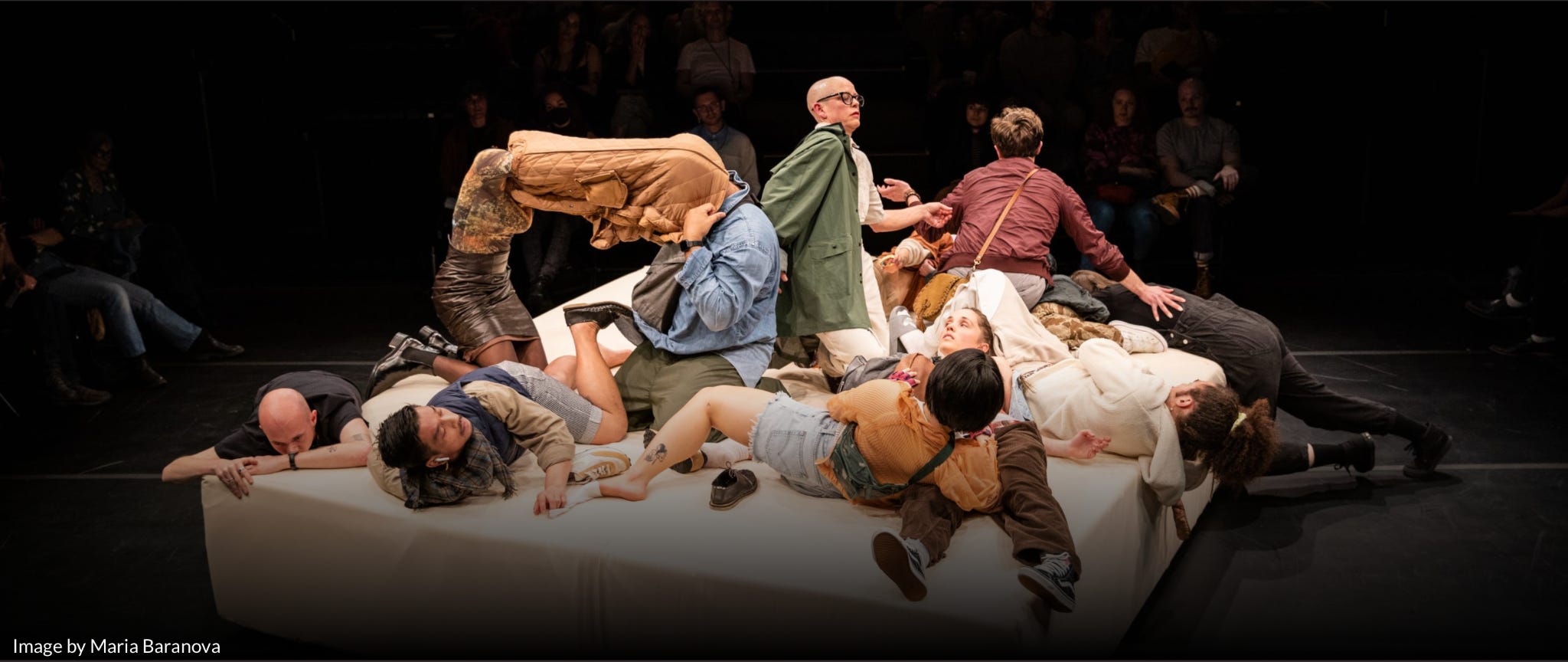
Faye Driscoll, Weathering, REDCAT, Los Angeles, 2025. Ten performers form the work through continually shifting relations among bodies, objects, and materials, with the audience watching at close range around the performance area. Photograph by Maria Baranova.
When Weight Becomes a Relationship
What I remember first about Faye Driscoll’s Weathering is the humidity of bodies. Performed by ten people, the work is described by Driscoll as a “multi-sensory flesh sculpture” composed of bodies, sound, scent, liquids, and objects. Weathering premiered at New York Live Arts in 2023 and has continued to tour through different cities; the version I encountered at REDCAT in Los Angeles was already part of this longer trajectory of development.
At first, layers of materials and bodies kept passing through. At moments it even reminded me of a fashion show: bodies, objects, sound, clothing, and liquids continually appeared. Under bright light, there was little place for the contact between skin, sweat, and material to hide. Although the performers were very close to me, my looking initially still projected outward—I was still “watching a work.” Then the whole structure began to move. Bodies collided, stacked, and supported one another; weight kept passing from one person to another. Fatigue, breath, and moisture changed over time. Later, one performer sat beside me, close enough that I suddenly no longer needed to “gaze” at that body.
It was simply there. At that moment, I did not even think of another performer so much as a stone, a plant, or some form of life sharing an environment with me. Not because the body had lost its human qualities, but because, for a moment, it did not need to show me anything. Breath, skin, and weight were enough.
This made me reconsider what “technique” actually is. If intimacy, trust, and physical precision gradually form through working together, might technique also exist within a relationship? Knowing when to give away weight, how to receive another person; within a precise structure, still needing to listen, wait, and judge rather than rush to control the next moment. I began to think about abilities that are difficult to contain within the phrase “dance technique”: receiving, waiting, adjusting, repairing, and re-establishing relation.
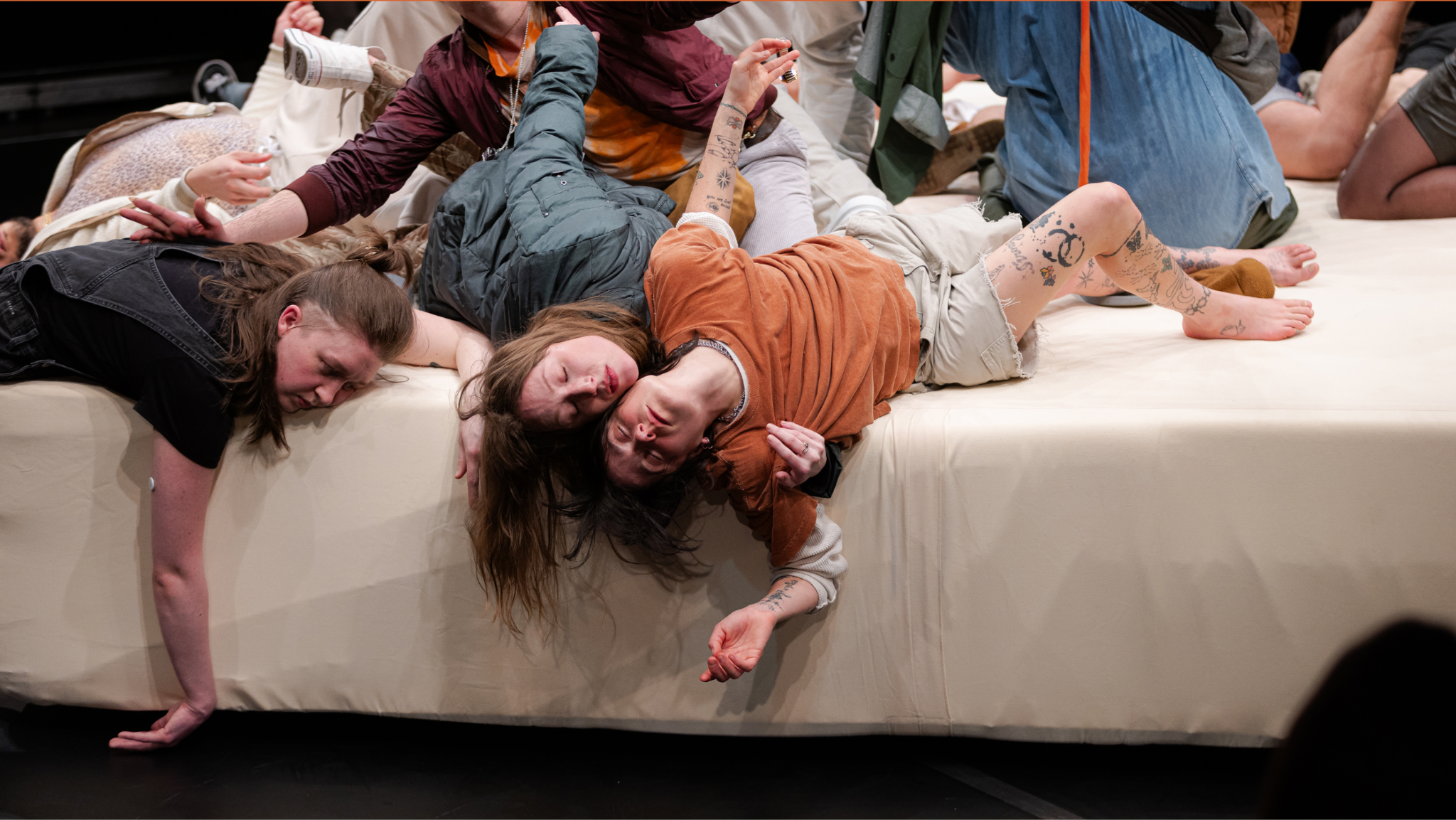
Faye Driscoll, Weathering, OZ Arts, 2025. Pictured: James Barrett, Amy Gernux, Emily Vizina, and Jo Warren. Photograph by Tiffany Bessire.
Recently, when I joined a class led by Faye Driscoll in Los Angeles, this question returned in another form. One exercise unfolded through sustained shaking. Looking back, what I remember is not which movements I completed, but the sense that desire, too, seemed to have weight. Continuous shaking allowed the body not to hurry toward changing anything; a very small resonance brought me close to something like grief. The boundary between conscious and unconscious did not disappear. Instead, it became perceptible through sustained vibration. I did not need to decide whether a movement was right or wrong. What mattered was how the body continued to receive, and how time allowed feelings that had been invisible to gradually surface. In that moment, I was not thinking about “correcting” a body, but about how a river already in motion might become perceptible.
Perhaps this is one way I now understand improvisation: it is neither “anything goes” nor a matter of returning things to their original place after a mistake. It is the ability to remain within a relationship after it has already changed, and to keep receiving the next moment.
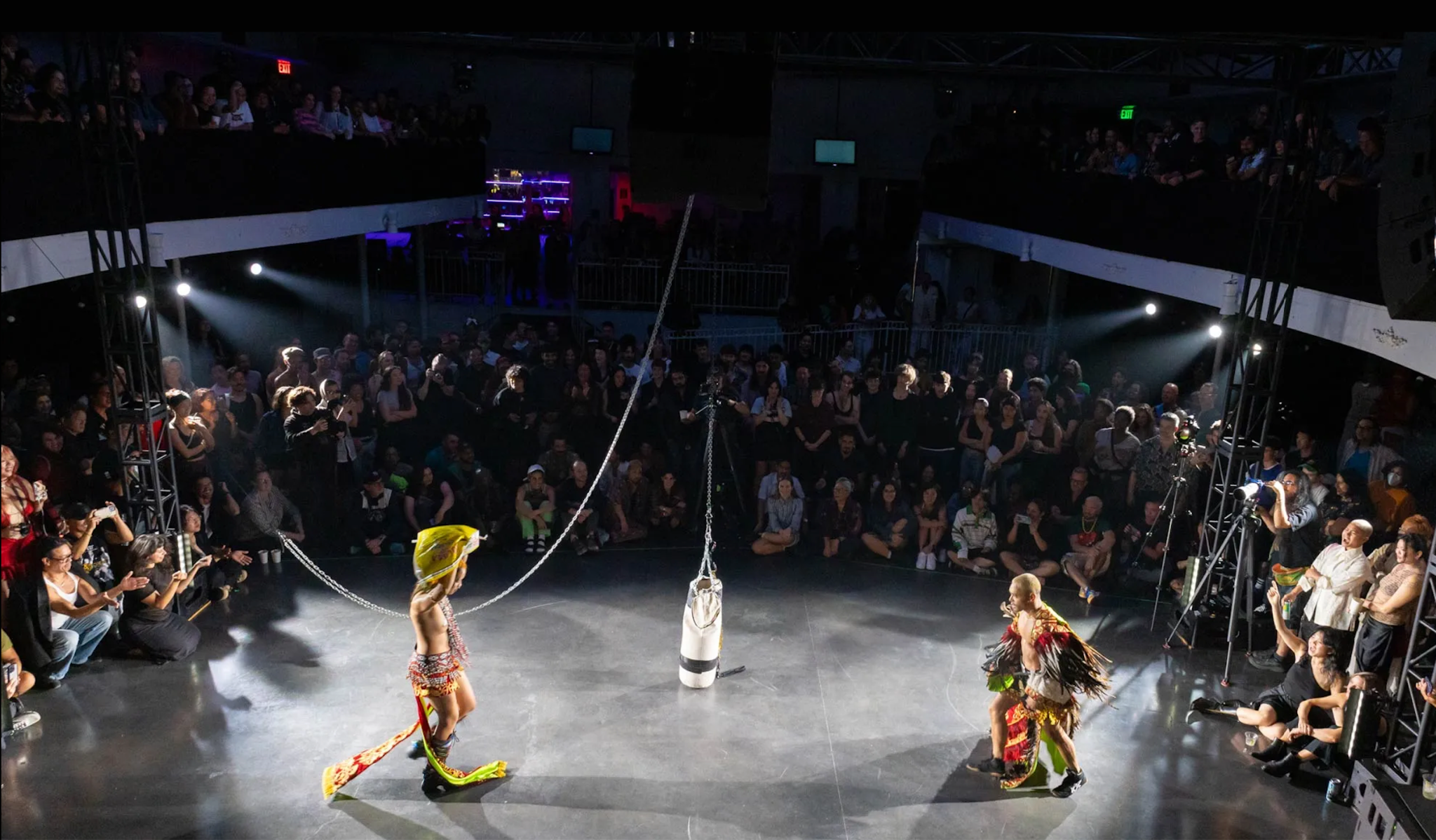
Jay Carlon, WAKE, Don Quixote, Los Angeles, 2024. Pictured from left: láwû makuriye’nte and Jay Carlon. The work also features Micaela Tobin. Photograph by Argel Rojo.
How Far From the Dance Floor?
On October 11, 2024, I saw the world premiere of WAKE, co-created by Jay Carlon and Micaela Tobin, at Don Quixote Nightclub in Los Angeles. The work was presented as an immersive club experience bringing performance and queer nightlife together, moving through Filipino American identity, ancestral memory, diaspora, mourning, healing, and collective gathering within the same night.
But looking back two years later, the first thing I remember is where I stood. I arrived early and found a position above the dance floor, looking down. Dancers, musicians, and audience members all entered my field of view. I could choose to remain at that distance, or walk down and move closer. “Where I stand” gradually became part of the act of looking itself. I remember the air feeling dense and sound reverberating through the room; I remember sandbags, impacts, and repeated physical actions. I was not familiar with every part of the work’s cultural context, and I did not need to pretend that I understood it completely. Instead, the body first gave me a position from which I could begin to move closer.
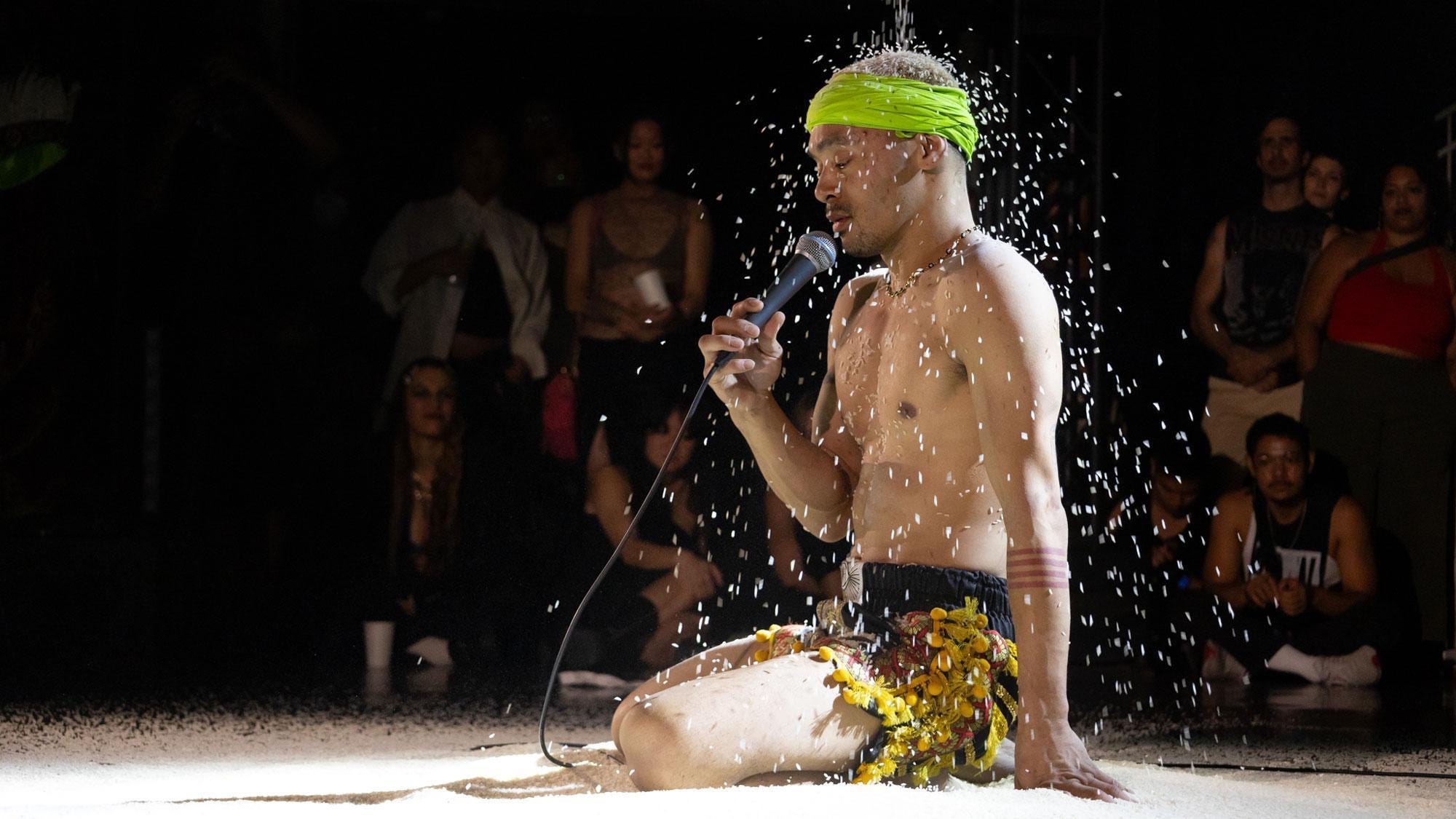
Jay Carlon, WAKE, Don Quixote, Los Angeles, 2024. Photograph by Argel Rojo.
If I could see it again, I think I would stand closer. This is one of the things I love about live performance: looking does not have to be completed in a single encounter. The first time I stand here; next time I might stand on the other side. The first encounter leaves me with impact and the density of the air; years later, what remains may be another kind of relationship.
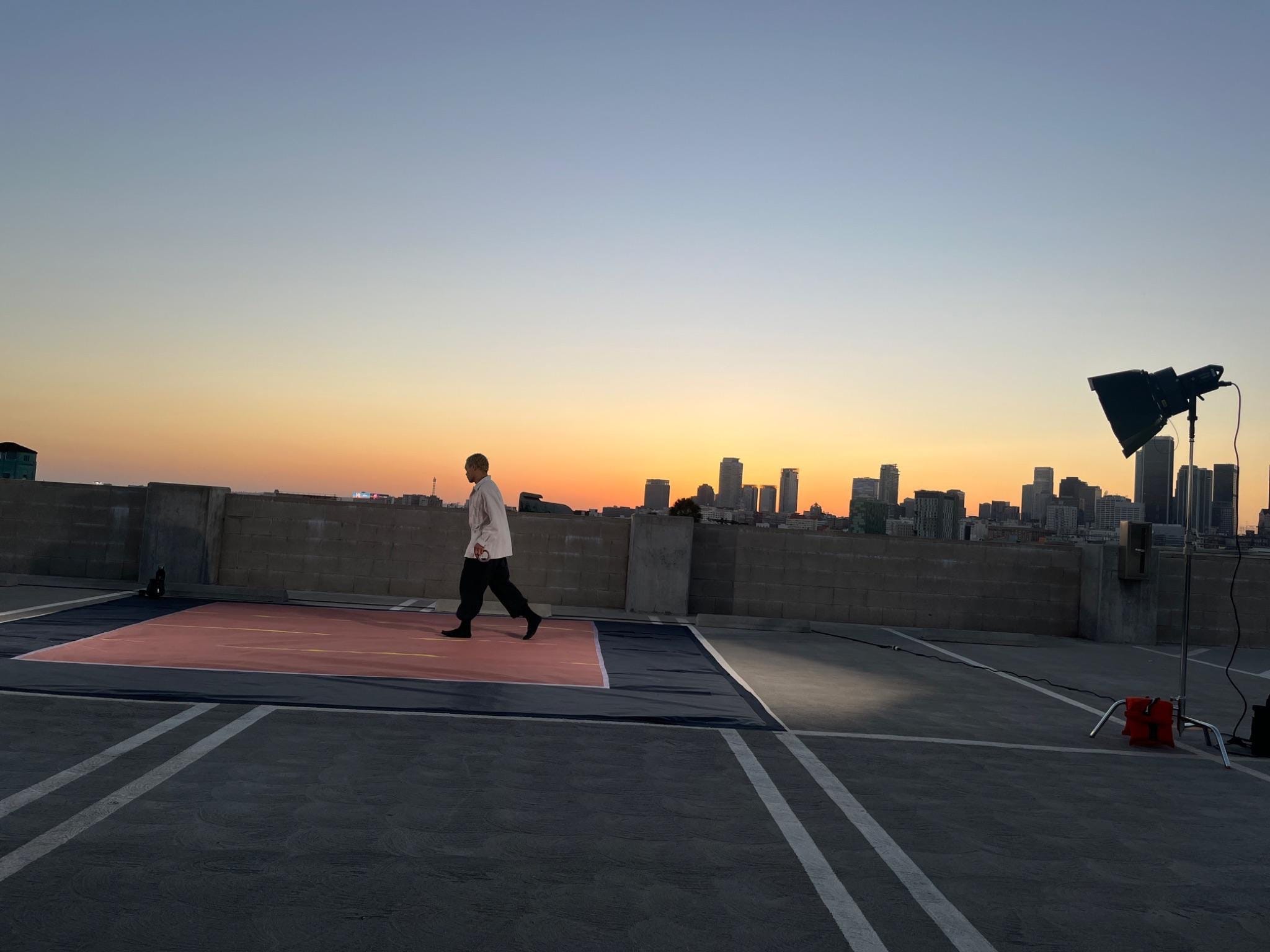
Jay Carlon, Dances on Paper, No. IV, USC Roski School of Art and Design, Los Angeles, 2026. Performed on the rooftop of a parking structure during the opening of the MFA Curatorial Practices Showcase, the very substance of ourselves. Photograph by Zelia ZZ Tan.
On September 17, 2026, I encountered Carlon’s work again at USC Roski in the Arts District. This time it was Dances on Paper, No. IV, performed on the rooftop of a parking structure during the opening of the MFA Curatorial Practices Showcase, the very substance of ourselves; the drawing left by—or related to—the performance remained on view for the duration of the exhibition. This was not another version of WAKE, but part of a different line of research. Yet placing these two encounters beside one another, I began to see how an independent artist’s practice moves between works: a different site, a different material, a different viewing distance, while the research of the body does not stop when a performance ends. Carlon’s practice often moves between dance, visual art, site, and community-based practices. Earlier versions of Dances on Paper used charcoal, graphite, sweat, and large sheets of paper to transform traces of movement into visual material.
Some bodily experiences may simply be difficult to describe movement by movement. I cannot remember the complete sequence of WAKE, but I remember traveling into a space I might not otherwise have visited, arriving early, and choosing where to stand. Sometimes looking does not begin with understanding and then move toward proximity. Sometimes we first find somewhere to stand, and understanding begins slowly from there.
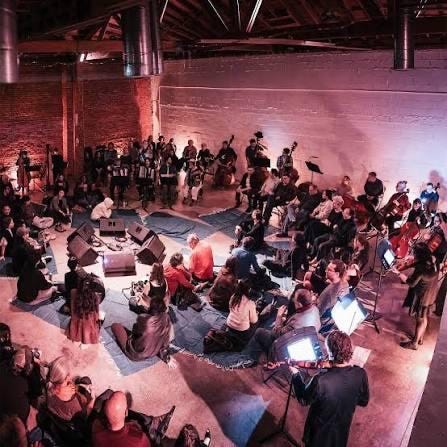
Wild Up and the Collective Orchestra perform Gavin Bryars’ Jesus’ Blood Never Failed Me Yet at 2220 Arts + Archives, Los Angeles, December 2025. Musicians are distributed throughout the space, with audience members gathered among them and speakers arranged in the central area. Photo: Sam Lee. Image via Wild Up and 2220 Arts + Archives social media.
A Score for Waiting Together
Another way of asking “where do I stand?” comes through sound.
In December 2025, I heard Wild Up perform Gavin Bryars’ 1971 work Jesus’ Blood Never Failed Me Yet at 2220 Arts + Archives in Los Angeles. The work grew from a recording Bryars obtained while working on a documentary about street life around Elephant and Castle and Waterloo in London: an unhoused man singing a brief melody. Bryars loops the voice, gradually adding strings and brass harmonies. For this performance, Wild Up extended the work through its Collective Orchestra format, inviting members of the public to learn with Wild Up musicians before the performance and join them in playing.
One of my friends was among those who received the score on the day of the performance and chose to participate. I sat close to the speakers. Audience members occupied the middle of the space, while musicians were distributed around the outer areas. In the dim light, I began to notice different people’s time: someone was already playing while someone else was still waiting; a sound entered from one direction, then another instrument slowly joined. The simple recording kept looping, but each time it returned, the surroundings were no longer exactly the same.
I knew some of the performers. A professor was playing trumpet; new friends spoke with me about harp, violin, and harmony. I did not suddenly become more knowledgeable about music, but I began learning how to listen: waiting for an instrument to appear from a particular direction, searching for the relationship between two sounds, and noticing how my own attention moved through space.
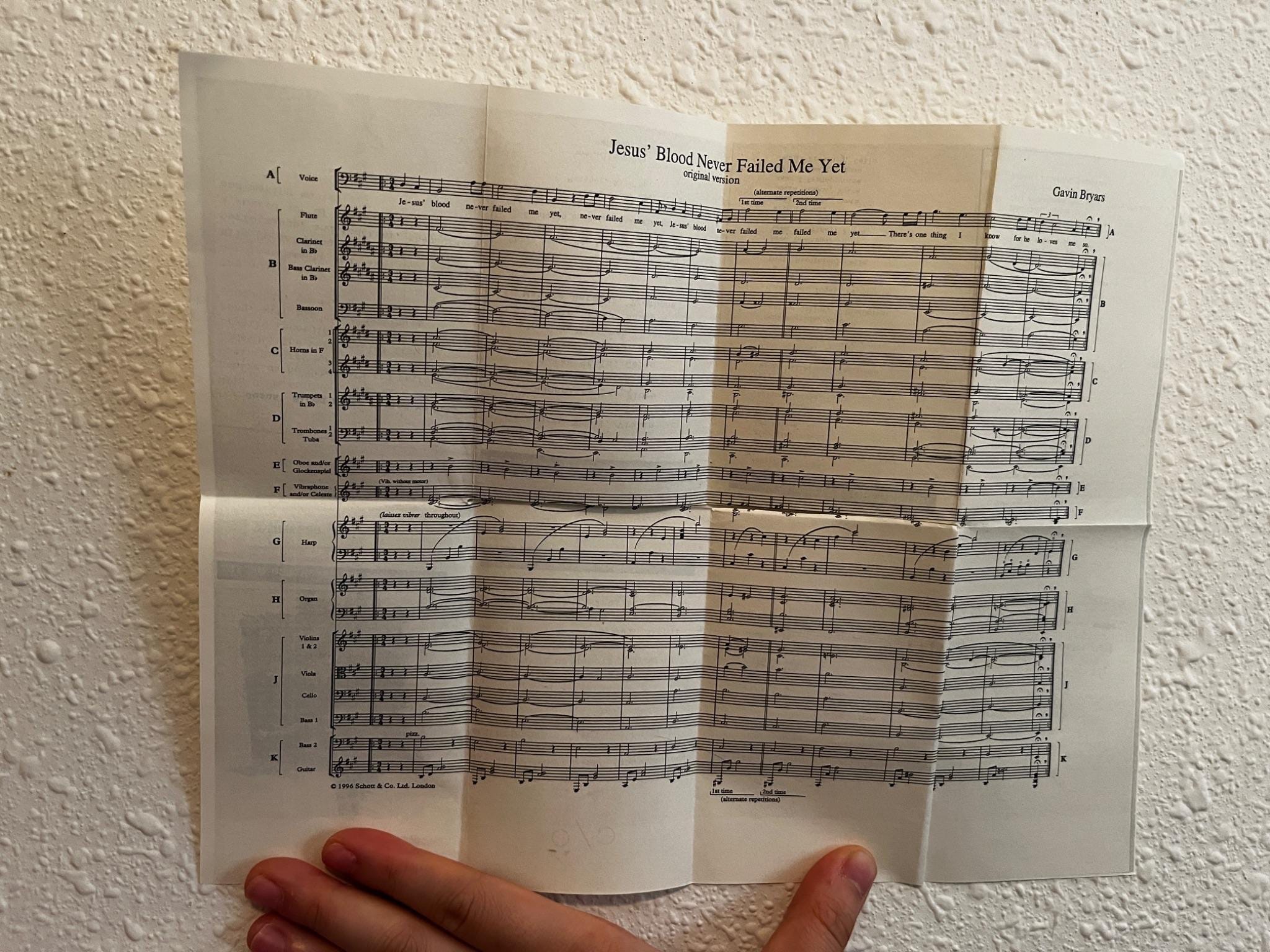
Score prepared for Wild Up’s performance of Jesus’ Blood Never Failed Me Yet, 2220 Arts + Archives, Los Angeles, 2025. Photograph by Zelia ZZ Tan.
Wild Up calls this model the Collective Orchestra, seeking to let community members rehearse and perform alongside ensemble musicians, deliberately loosening the boundary between “orchestra” and “audience.” For me, a score therefore does more than record sound. It also arranges: who enters, who waits, who needs to hear whom, and how a group passes through a stretch of time together.
This is completely different from the weight in Weathering, yet it brought me to a similar question. In one, weight passes from one body to another; in the other, sound enters another person’s time. A world gradually accumulates through weight, sound, and waiting, becoming perceptible. Perhaps one of the most difficult techniques of improvisation is precisely this: making a choice within someone else’s time.
Leaving and Coming Back Within Seven Hours?
Patrick Blenkarn and Milton Lim’s asses.masses pushes this question further. It is a video game made for the theatre, played from beginning to end by the live audience, with the full experience lasting more than seven hours. A single controller sits at the front. Audience members take turns becoming the player, while everyone else watches, offers suggestions, cheers, and, when necessary, renegotiates who should take over. One of the questions the creators themselves raise is: Is the person holding the controller the leader? Or is it the person sitting in the back who happens to know how to solve the level? When does leadership need to change hands?
The donkeys in the game have names such as Sick Ass, Bad Ass, Smart Ass, Sad Ass, and Kick Ass. “Ass” means donkey, while also continually borrowing from English double meanings and slang, so each character arrives with a slightly absurd personality already embedded in its name. The game deliberately moves across different visual and interactive forms, from nostalgic 2D worlds into 3D spaces. Different game genres call for different skills, which can also prompt the controller to change hands.
I remember one sequence in which we had to enter a heavily secured space and rescue a trapped donkey. At one point, two donkeys needed to escape at the same time, and even two people were handling the same controller together. People below began shouting directions and proposing solutions, but no one really knew the single correct route. Someone would give up the controller because it became too difficult; someone else would take over; someone would simply call out ideas from the back. Strangely, these exchanges did not interrupt the story. The world shifted from 2D to 3D, the player changed, and the mode of control changed, but the people in the room remained the same. Familiar voices were still there; the people who had failed a moment ago were still there. We gradually developed jokes and tones of voice that existed only for that night. The digital worlds kept changing; the social relationship in the room became the most continuous layer.
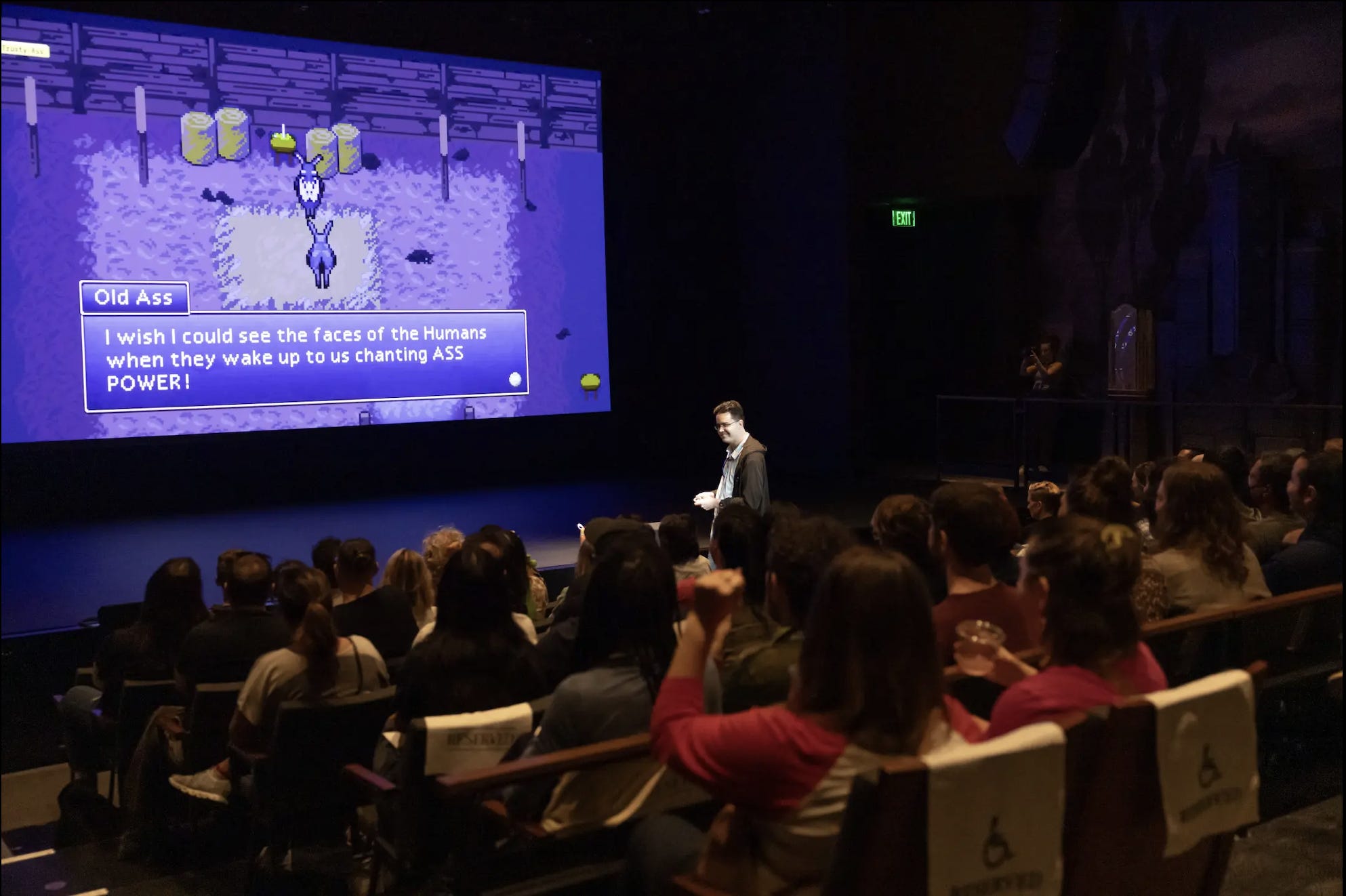
Patrick Blenkarn and Milton Lim, asses.masses. Audience members respond collectively to choices in the game through cheering, disagreement, and discussion. Photograph by Myung J. Chun / Los Angeles Times.
More than seven hours cannot, of course, sustain a single mode of attention. The work includes several intermissions and allows the audience to move around, eat, and rejoin. The creators compare it to a very long collective game night rather than a conventional two-hour theatre experience.
I remember going out to get something to eat, then coming back. That small action later became unexpectedly important: leaving did not end my act of looking. The pause extended the experience.
When I stepped outside, I temporarily left the rhythm of the game. When I returned, I had to work out where we were, who was holding the controller, and how the atmosphere in the room had changed. I could decide when to move closer, when to rest, and when to give my attention back to that world. This voluntary exit and return gave “immersion” another meaning for me: immersion does not necessarily mean forgetting the world outside. It may mean that I am free to leave, yet choose, again and again, to come back.
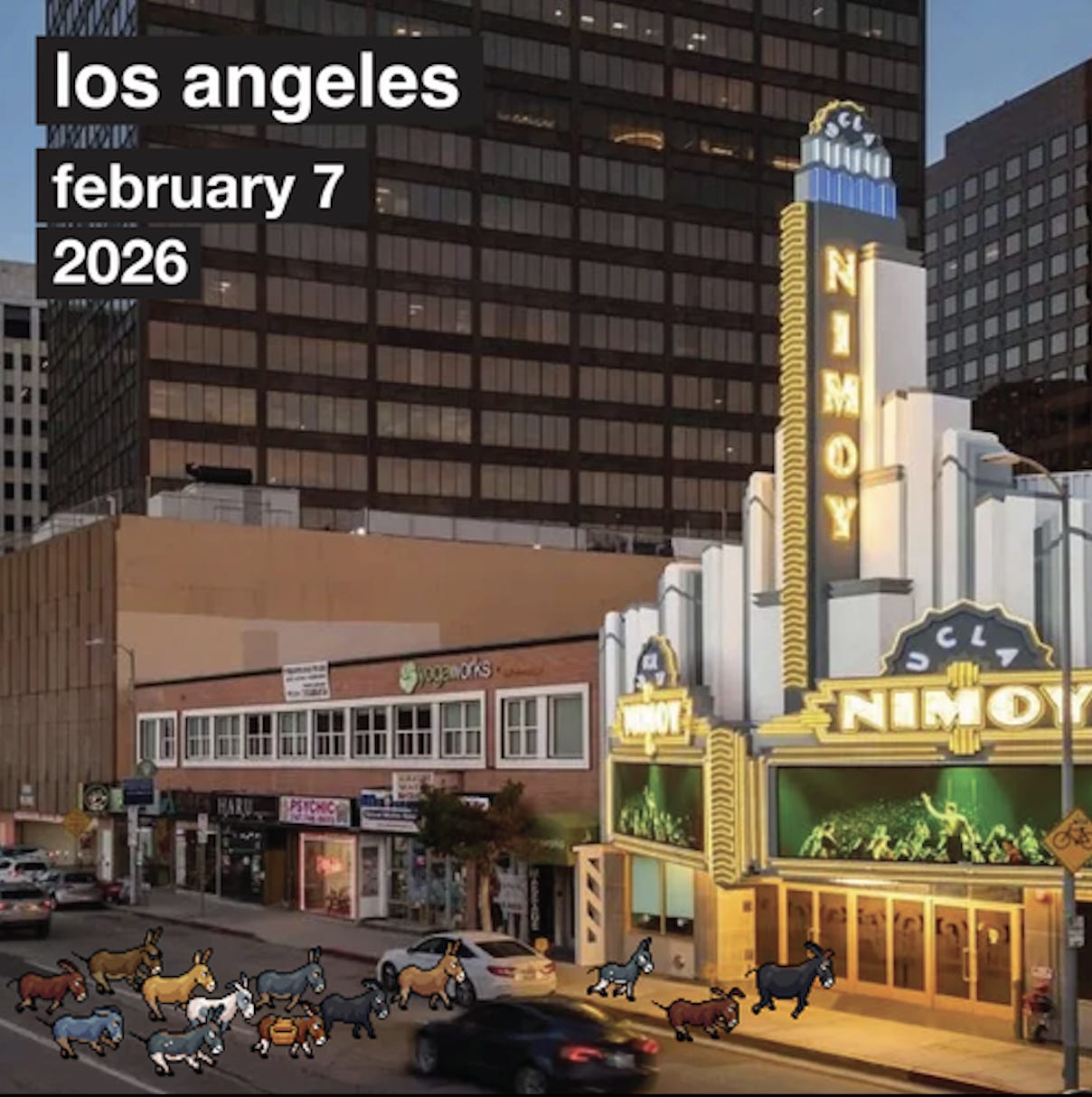
Patrick Blenkarn and Milton Lim, asses.masses, Los Angeles performance promotional image, 2026. The work follows a group of donkeys displaced from their jobs by machines, while the audience collectively plays through 2D and 3D game worlds. Image from the work’s official website.
What draws people in is not only the game’s levels. It comes from the time accumulated through playing together: strangers begin to recognize one another’s voices, learn who is better at navigating a 3D camera, who likes solving puzzles, and who is always shouting from the back. Choices sometimes move the story forward; at other times, they simply shift the atmosphere of the room. The game is therefore not only a narrative unfolding on a screen, but a group of people who did not know one another gradually working out how to make decisions together.
My body was not dancing, but my time had entered the work. If choreography can also concern time, attention, entering and leaving, waiting, deciding, and the temporary relations formed among bodies, then what exactly was I watching: only a game, or a form of collective composition made possible through the rules of a game?
When My Position Begins to Shift
Looking back at these works, I can no longer remember every stage in full, but my body still remembers certain relations: one person’s weight eventually arriving beside me; standing above the dance floor and later wishing I had moved a little closer; a sound entering from one part of the room and another person joining it; within more than seven hours, stepping out to eat and then returning to a world of people and donkeys.
They use completely different media and are not speaking about the same thing. I do not want to call everything “choreography” simply because I am a choreographer. But each of them changed the distance between me and the work, and made me reconsider whether criticism necessarily means standing outside a work.
For me, perhaps the opposite is true. The position from which I look is itself part of criticism. What matters is not treating “what I felt” as the answer to a work, but identifying the methods through which the work altered my position: What made me move closer? What made me wait? What made me willing to give away my time? What allowed the time of strangers to overlap, temporarily, with my own?
This has also gradually affected how I understand my own making and teaching. I ask less often, “What movement do I want to arrange?” and more often, “What does an environment allow people to practice?” Can it let us practice waiting? Can we receive another person’s choice? After a relationship changes, can we resist rushing to restore it and instead continue from a new position?
Perhaps this is how the world of a work temporarily comes into being. Not when every element finally fits together without friction, but when bodies, sounds, spaces, objects, and audiences begin to genuinely affect one another.
What I want to keep noticing is the moment, within that process, when my own position begins to shift.
Read the original Chinese version here: https://www.iatc.com.hk/doc/108005